
⚙️ Under the Hood #6
The tech inside your racket is smarter than you think.

On Monday, I wrote about India’s racket sports revolution — the Thomas Cup bronze, squash heading to the Olympics, pickleball exploding across tier-2 cities, and the maidaan-to-court shift reshaping Indian sport.
Today I want to talk about the stuff you can’t see. Because behind every Lakshya Sen smash and every Anahat Singh drop shot, there’s a layer of technology that’s quietly changing how racket sports are played, coached, officiated, and watched.
And some of it is genuinely wild.
The shuttlecock is the fastest object in sport. And we can prove it.
Here’s a fun fact to ruin your next dinner party: the fastest recorded badminton smash is 565 km/h. And it was hit by an Indian.
Satwiksairaj Rankireddy — half of India’s world No. 1 doubles pair — holds the Guinness World Record for the fastest badminton hit, set in April 2023 at Yonex’s Tokyo facility. For context, 565 km/h is faster than the fastest tennis serve ever recorded (263 km/h), faster than a Formula 1 car at top speed (around 370 km/h), and roughly 1.5x the cruising speed of a bullet train.
How do they even measure that? A NAC Image Technology ultrahigh-speed camera capturing 40,000 frames per second — that’s about 1,000 times faster than your phone camera. The speed is then verified using Hawk-Eye tracking technology, the same multi-camera system that decides whether a shuttle landed in or out during matches.
Which brings me to the first piece of tech you see every match but probably don’t think about.
Hawk-Eye: the umpire that never blinks
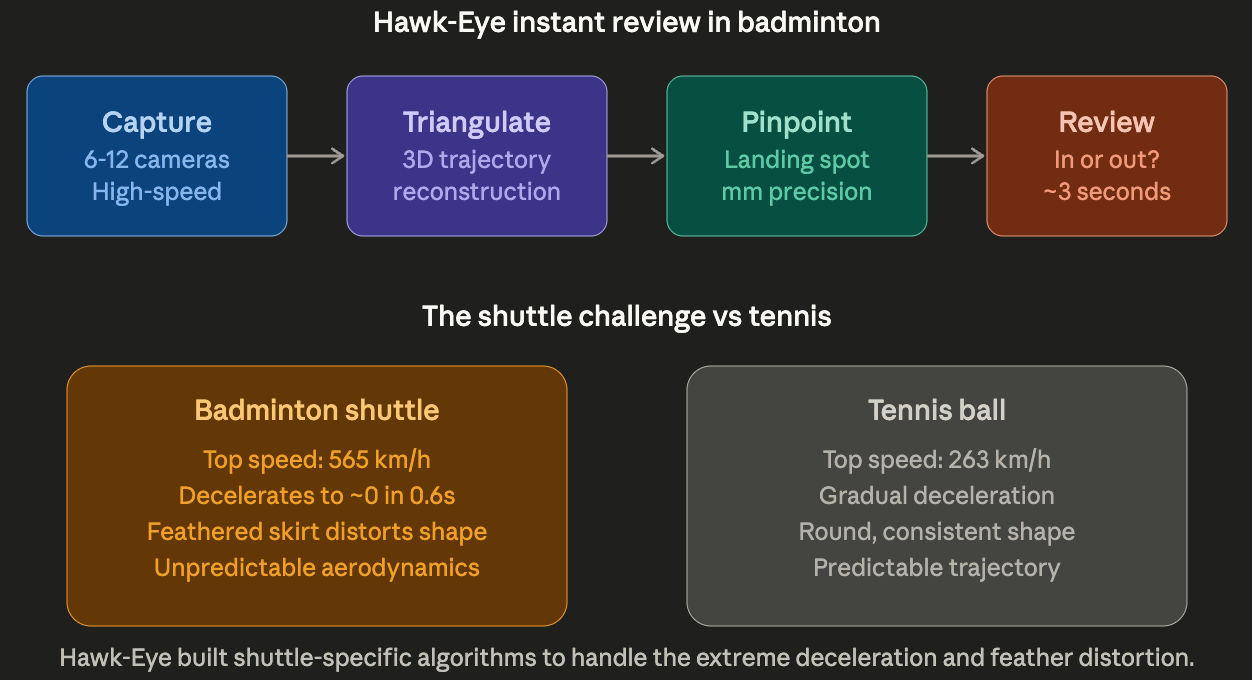
If you’ve watched any BWF Super Series match in the last decade, you’ve seen the Instant Review System. A player challenges a line call, the arena goes quiet, and a 3D graphic shows exactly where the shuttle landed — down to the millimetre.
That’s Hawk-Eye. The BWF adopted it in 2014, and here’s how it works: 6-12 high-speed cameras are mounted around the court, each with a precisely calibrated position. The system triangulates the shuttle’s position from multiple angles, reconstructs its 3D trajectory using physics-based filtering, and pinpoints the exact landing spot — all in about three seconds.
The challenge? Badminton’s shuttle is genuinely harder to track than a tennis ball. It’s smaller, lighter, decelerates from 400+ km/h to near-zero in a fraction of a second, and its feathered skirt creates unpredictable aerodynamic drag. Researchers at the National Chung Hsing University published a paper on how conventional ball-tracking algorithms break down with shuttlecocks — the feathers distort the shape detection, and the extreme deceleration curve confuses trajectory prediction models.
Hawk-Eye solved this by building shuttle-specific algorithms that account for the unique aerodynamics. And when the BWF World Championships come to Delhi in August, every court will have this system running. The umpire of the future doesn’t blink, doesn’t have biases, and processes 40,000 frames per second.
Your racket is becoming your coach
Here’s where it gets interesting for regular players — not just pros.
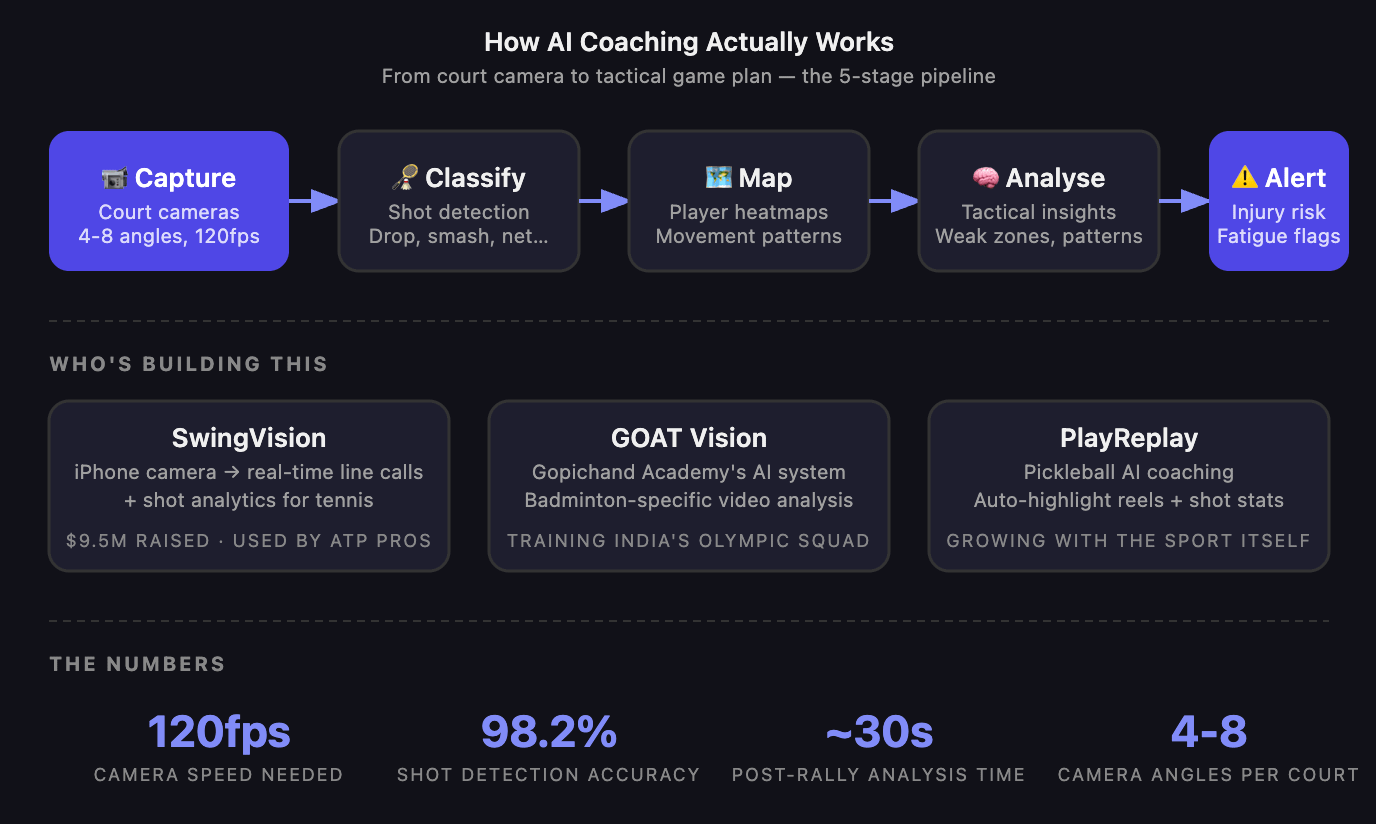
Smart racket technology is moving fast. Yonex has integrated lightweight sensors into racket handles that measure swing speed, impact force, and angle of contact. Machine learning algorithms classify your strokes — smash, drop, clear, drive — and tell you what you’re doing wrong before your coach does.
A 2024 research paper from the Chinese Academy of Sciences demonstrated a “self-powered intelligent badminton racket” — no batteries needed. The sensor harvests energy from the impact of hitting the shuttle itself, using piezoelectric materials that convert mechanical stress into electricity. The racket powers its own analytics. Think about that: the harder you hit, the more data it collects.
For amateur players, these sensors act as digital mentors. They can detect over-rotation in your wrist, delayed contact points, or inefficient swing paths — the kind of subtle technical flaws that take a human coach weeks to diagnose. They can even warn you when your technique is putting too much stress on your joints, potentially preventing the kind of injury that took Lakshya out of the Thomas Cup semi-final.
AI is watching your matches (and learning)
Beyond the racket itself, AI-powered video analysis is transforming how coaches break down matches.
Traditional match analysis meant a coach watching hours of footage, manually noting patterns. Now, AI systems can process an entire match in minutes — identifying shot types, tracking player positioning, generating tactical heatmaps, and spotting tendencies that a human eye would miss over 50 rallies.
SwingVision — a startup that raised $9.5 million — provides automated stats, highlights, and even officiating for amateur racket sports players. Point your phone at the court, and it tracks your rallies, scores your games, and generates a post-match report that would have required a professional analyst five years ago.
This tech isn’t just for badminton. In pickleball, PlayReplay has partnered with professional leagues to roll out AI-powered officiating at PPA and MLP matches in 2026 — cameras mounted on net posts track line calls, foot faults, and kitchen violations in real time, while also capturing shot type, ball speed, spin rate, and placement.
And the Gopichand Academy? It’s using GOAT Vision technology alongside its roster of sports scientists, biomechanics experts, and nutritionists. The academy that runs on Gopichand’s coaching philosophy is now augmented by data that tells him things his eyes can’t.
Squash’s glass court is straight from the future
If you think badminton tech is wild, squash is on another level.
The ASB ShowGlassCourt — the all-glass court used in PSA World Tour events — is essentially a giant transparent box with a front wall that doubles as an interactive screen. Player stats, replays, and sponsor content are projected directly onto the playing surface during breaks. Players literally compete inside a screen.
But the really wild part is the broadcast tech. The PSA recently signed a deal with Sports Data Labs making squash the first professional sport ever to make in-game physiological data available for commercialisation. Real-time heart rates, recovery metrics, and exertion data are integrated into the live broadcast. You’re not just watching two players rally — you’re watching their bodies respond.
And with interactiveSQUASH, the PSA is streaming live tournament coverage directly to smart courts worldwide — projected onto the front wall of your local club. Your neighbourhood squash court can become a cinema showing the world championships. When squash debuts at LA 2028, expect this tech to blow up.
India is building the court-booking OS
One last piece of the tech stack that’s easy to overlook: the apps that make it all work.
Playo and Hudle are two Indian startups building what I’d call the “operating system” for recreational sport in India. Court discovery. Booking. Player matchmaking. Community building. Coaching connections.
Hudle operates across 105 cities, has raised $5.8 million in funding, and is seeing fast adoption in tier-2 cities like Indore, Lucknow, and Coimbatore — exactly the cities where the racket sports revolution is happening. Playo, based in Bengaluru, has raised $2.6 million and does ₹20.5 crore in annual revenue.
Think of what Swiggy did for restaurants and Uber did for cabs. These apps are doing it for courts — taking the friction out of “I want to play.” When there are 1,200+ pickleball courts and 300+ padel courts across India, someone has to help you find the empty one at 7 PM on a Tuesday. That’s not a small problem. That’s infrastructure.
📋 The Scoreboard #5 - The quick hits from across the board
🎾 Sinner is terrifying everyone. 29-match win streak entering the French Open — the longest since Djokovic in 2011. Five Masters 1000 titles this season alone. Alcaraz is injured and watching from home. The question isn’t whether Sinner wins Roland Garros. It’s whether anyone on earth can take a set off him right now. Spoiler: probably not.
⌚ Your Apple Watch now knows which racket sport you’re playing. The latest WatchOS update includes a “racket sports” workout mode — swing count, rally duration, movement intensity — across badminton, tennis, pickleball, and squash. Four racket sports. One watch. The algorithm identifies which sport you’re playing from your wrist movement alone. We live in the future and nobody told us.
🚗 The electric SUV war just got real. Hyundai Ioniq 9 launched in India — first full-size electric SUV under ₹70 lakh. 620 km range. 0-100 in 5.2 seconds. Three rows. If you were waiting for EVs to get big enough for your family and your ego, this is it.
✈️ India just made it easier for the world to visit. E-visa on arrival now available for 150+ countries — up from 113 last year. Processing: 72 hours. If you’re planning to fly in for the BWF Worlds in Delhi this August, the paperwork just got a whole lot simpler. Now if only they’d fix the airport immigration queue. 😅
💬 I want to hear from you
Would you pay more for a “smart court” experience — with cameras, analytics, and instant replay — or do you prefer the no-frills warehouse vibe? I’m genuinely split on this one. The tech nerd in me wants data on every shot. The Surat kid in me just wants four walls and a net.
Drop a comment, reply to this email, or hit me up on X or LinkedIn. The best responses get featured next week.
⚡ Coming up on Offside Notes
Next Monday: 🏟️ The Opening Whistle #7 — “India’s biggest sports month ever. And nobody’s ready for it.”
June 2026 might be the most stacked month in Indian sports history. The IPL final just crowned a champion. The FIFA World Cup kicks off June 11 — the first-ever 48-team tournament across three countries — and India still doesn’t have a confirmed broadcast deal. The French Open finals land June 6-7, with Sinner chasing history. India hosts Afghanistan for a one-off Test in Chandigarh on June 6. And Wimbledon starts June 29. We’re breaking it all down.
If you missed Monday’s Opening Whistle #6 on India’s racket sports revolution, read it here — today’s piece is the tech companion to that story.
If someone forwarded this to you and you’re wondering what this is — Offside Notes is a weekly newsletter about sport, tech, travel, and the things that move us. Subscribe so you don’t miss what’s next. ⚡